
Introduction
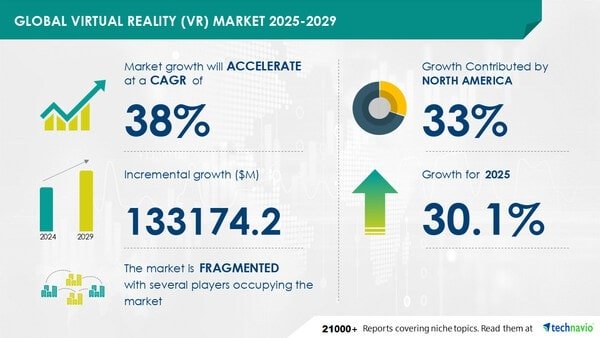
The virtual reality (VR) market and its associated gaming segment are experiencing a noticeable decline after a period of hype. Sales of VR hardware have decreased, and the pace of content adoption has slowed. This puts companies providing VR services at risk, as the temporary reduction in demand may negatively impact their revenues and valuation. However, for many market players, the downturn is cyclical, and prospects for the next 1–2 years are linked to an expected recovery in demand. Below, we examine key trends in demand for VR development, investor attitudes toward temporarily unprofitable companies with strong assets, examples of studios that have overcome challenges, and the impact of participation in industry exhibitions.
Demand for VR Development: Games, Education, and Entertainment
The State of the VR Gaming Market from Developers’ Perspective
According to developer assessments, 56% of respondents consider the VR gaming market to be stagnating or declining, while only 24% see growth (Game Developer Collective survey data). This reflects the current low consumer demand and limited VR audience.

Decline in the Consumer VR Market
In 2023, the consumer VR market experienced a sharp decline. According to Omdia, global VR headset sales dropped by 24% (from 10.1 million units in 2022 to 7.7 million in 2023). The active user base has effectively stabilized (~23.6 million headsets), and only slight growth is expected in the coming years. At the same time, spending on VR content also declined: in 2023, users spent $844 million, compared to $934 million the previous year.
The reasons for the decline include a combination of economic factors (inflationary pressure on consumer spending) and disappointment in the technology: new devices lacked a “killer app” capable of attracting a mass audience. For example, even the high-profile launch of Apple Vision Pro did not bring about a revolution—developers estimate that Apple’s impact on the market remains minimal.
Most VR games remain niche, and development profitability is challenging due to the modest user base. As a result, 56% of game developers believe the VR gaming market is currently stagnating or shrinking. The main reasons are the high cost and inconvenience of headsets for the average user, as well as the absence of truly essential content. Many consumers are still not willing to wear a heavy device on their heads for long periods, and the novelty of VR games quickly wears off without deep replay value.

Growth Segments: Education and Training
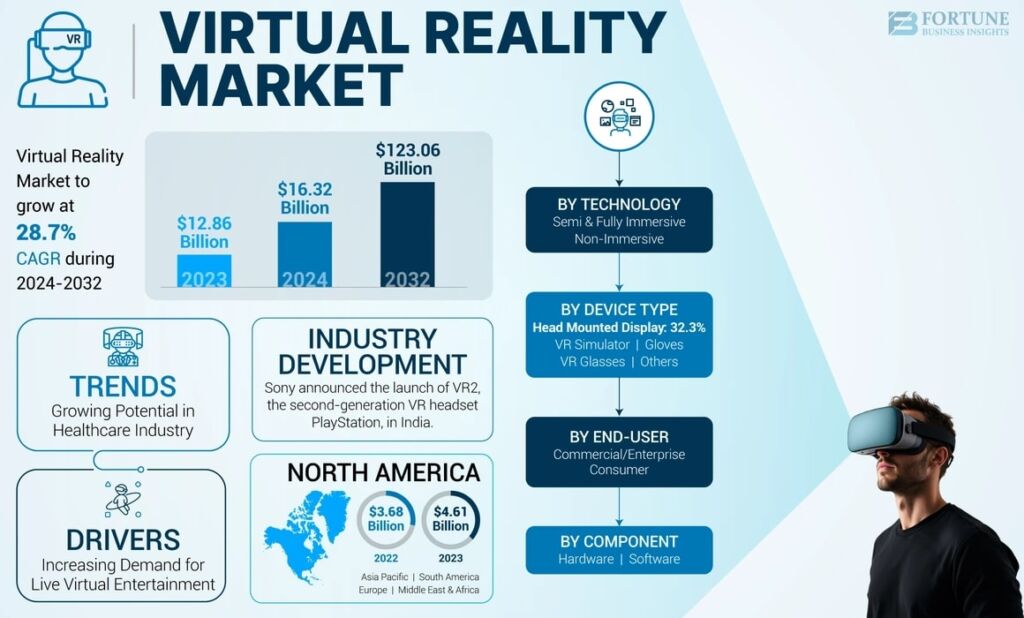
While purely entertainment-focused VR is hitting an audience ceiling, the use of VR in education, training, and the B2B sector is showing steady growth. Companies are increasingly adopting VR for employee training: analysts estimate that the VR education market will grow from $4.4 billion in 2023 to $28.7 billion by 2030 (an annual growth rate of ~30%). By 2030, enterprise users will generate more than 60% of all VR industry revenues.
The reasons are clear: VR training has proven to be effective and cost-efficient. For example, PwC research shows that VR training is four times faster than classroom training, and learners feel 275% more confident in applying acquired skills. VR allows for the simulation of situations that are either inaccessible or too expensive to recreate in real life (e.g., manufacturing, medicine, military training), increasing corporate clients’ interest in such solutions. Even during economic downturns, companies continue investing in VR training as a way to reduce costs and improve workforce efficiency.
Thus, demand for VR development is segmenting: while the gaming and entertainment sector is experiencing temporary stagnation, interest in education, training, and industry applications is growing. VR development studios focused solely on games now find it harder to attract clients, but expanding into related fields (edtech, simulations, marketing) can compensate for declining gaming demand.
Investor Evaluation of Unprofitable Companies with Strong Intangible Assets
During crises, investors become more cautious, which affects funding for VR/metaverse startups. In 2023, venture capital investments in VR/AR projects and virtual worlds fell to their lowest levels in recent years. Many funds shifted their focus to more applied fields, leaving consumer VR startups struggling with a funding shortage.

However, for companies with strong intangible assets and a long-term vision, investors still assess the potential for recovery, even if financial performance is currently negative. In the modern digital economy, intangible assets have become decisive: on average, they account for up to 87% of a company’s total value (including intellectual property, software, brands, and expertise). During periods of growth, this goes unnoticed, but in a crisis, their role becomes crucial.
According to the International Valuation Standards Council, brands and other intangible assets are now critical competitive advantages, and companies that know how to leverage them are more resilient during downturns.
Strategic Assets and Investor Confidence
When facing temporary unprofitability, investors look at strategic assets and long-term prospects. If a company has unique technology, patents, a strong team, or a loyal community, the market factors these into its valuation—even if current profits are negative.
For example, many major players continue investing in VR for the future: Meta (Facebook) incurs billions in annual losses in its VR division but sees this as an investment in the long-term metaverse. Similarly, a startup with negative cash flow but a unique VR engine or a popular game may receive an “advance of trust” from investors.
Experienced investors use downturns as opportunities to invest in promising companies at lower valuations, expecting value growth when the market recovers. In past crises, leading funds adopted this strategy: although startup valuations fell by an average of 25–40%, the best projects still secured capital—sometimes even more easily, as there was less competition for deals.
Case Studies: Challenges and Strategies for Overcoming the Downturn
The current downturn has affected many VR studios, including well-known ones. In late 2024 – early 2025, several leading VR game developers announced staff cuts due to weak sales.
For instance, Swedish studio Fast Travel Games (creators of several successful VR games) had to lay off 30 employees out of ~70 after six game launches in 2024 with sales below expectations. The company’s leadership explicitly pointed to an “uncertain year ahead for VR games” and the need to reduce costs for future stability.
Similar reports came from other studios: in October 2024, UK-based XR Games cut ~40% of its staff, in September 2024, nDreams laid off up to 17% of its workforce, and in January 2025, Soul Assembly announced ~15% layoffs. These cases illustrate that even experienced teams struggle with the profitability of VR projects in a contracting market.
Successful Adaptation Strategies
Despite the challenges, some VR developers have successfully adapted. Facing low consumer demand, certain studios have pivoted toward corporate sectors or adjacent services.
For example, U.S.-based PIXO VR initially focused on VR entertainment but shifted to VR training for businesses. They leveraged their gaming development and artistic expertise to create immersive training modules (e.g., industrial safety) and implemented a new sales strategy. This pivot into VR education quickly paid off: inbound leads quadrupled, and contracts with several Fortune 500 companies were secured.
Another example is the startup Pixvana, which realized in 2019 that the mass market for its VR video platform was not yet ready. Instead of shutting down, the team changed its product niche—leveraging its video expertise to create Voodle, a new short video messaging service for team communication. In essence, Pixvana exited VR entirely, but this move allowed it to retain its team and investments, avoiding failure due to a narrow market.
For gaming studios, a common strategy is to scale down and wait for the next market growth phase. Fast Travel Games, in addition to layoffs, secured additional funding—in spring 2024, it received investment from MetaVision, providing financial stability for future projects. The studio also reported reaching one million cumulative game sales, demonstrating portfolio value to investors.
Conclusion: Survival Strategies for VR Companies
The key to surviving a crisis in the VR market is maximum adaptability. The studios that successfully navigated the downturn optimized costs, diversified their business, and preserved the value of their intangible assets (technology, IP, or team).
Market recovery is expected by 2026, so the challenge for VR companies is to endure until then—while simultaneously developing new opportunities to emerge from the downturn stronger, not weaker.


